

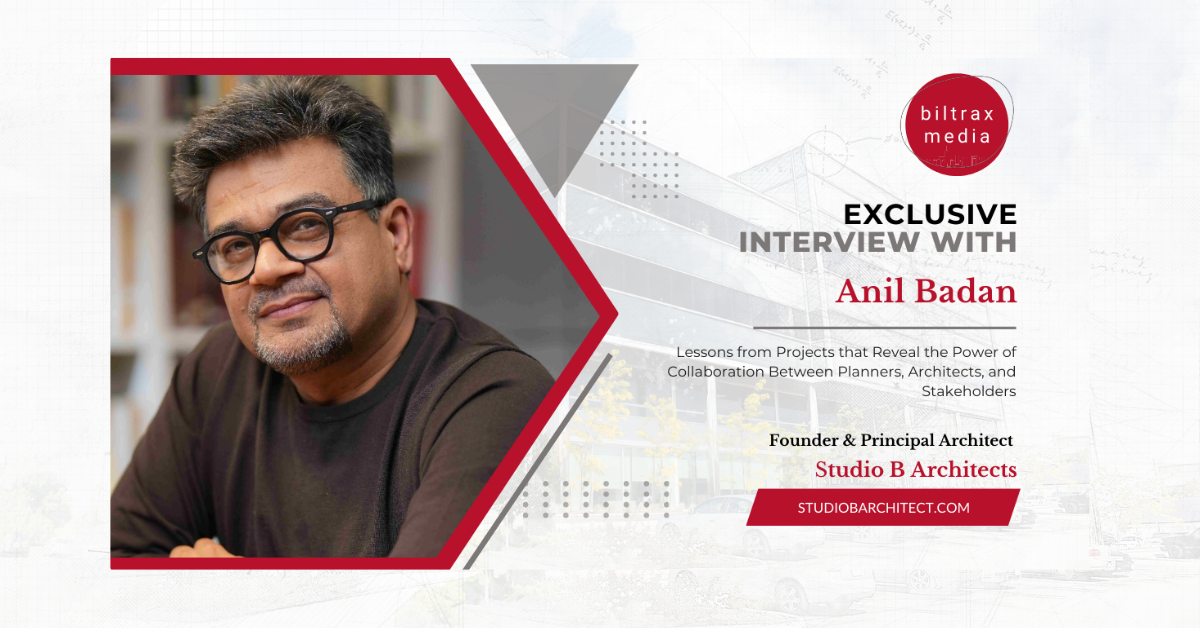
In this article by Ar Anil Badan from Studio B Architects, Biltrax Media explores “Lessons from Projects that Reveal the Power of Collaboration Between Planners, Architects, and Stakeholders”.
In architecture, no great project is ever built alone. The real magic happens when planners, architects, and stakeholders bring their perspectives together, transforming ideas into spaces that truly connect with people. This shared approach—collaboration in architecture—is what turns challenges into possibilities and designs into experiences.
The Alchemy of Overlapping Ideas
There’s a certain alchemy that happens when ideas begin to overlap—when the planner’s logic, the architect’s intuition, and the stakeholder’s vision start to speak to one another. That’s when design stops being a solitary pursuit and becomes something larger: a shared creation. As Ar. Anil Badan, Founder and Principal Architect of Studio B Architects, I’ve realised over the years that collaboration is not an accessory to architecture; it is its foundation. Every hotel I’ve designed, every resort I’ve walked through with a team of planners and craftsmen, has reminded me of this truth.

Collaboration in Challenging Terrains: The Khyber Himalayan Resort & Spa
When we designed the Khyber Himalayan Resort & Spa in Gulmarg, for instance, collaboration was not a choice but a necessity. The terrain was demanding, the weather unpredictable, and the craftsmanship deeply local. The planners brought in structural and logistical wisdom that grounded the design; the local artisans lent authenticity through their materials and techniques. Together, we shaped a space that felt as though it had grown from the mountains themselves, pinewood, carved ceilings, and light that changes character with the snow outside. It was not a single mind’s creation, but a collective one.
Dialogue as a Design Tool: Ramada Plaza, Varanasi
That spirit of dialogue extends to every project, no matter its scale. In Varanasi, when we worked on the Ramada Plaza, conversations with planners often revolved around flow and efficiency, how guests move, how staff circulate, and how light filters through corridors. But those functional discussions became moments of creative discovery. A planner’s concern about service routes might inspire an architectural feature; a client’s operational insight could lead to a more intuitive lobby. Design evolves when everyone is part of the conversation.
Listening to the Site and Its People: Fort Rajwada, Jaisalmer
Collaboration, for me, has also meant learning to listen, truly listen, to the site and to the people who inhabit it. At Fort Rajwada in Jaisalmer, that meant respecting the desert’s rhythm. The planners and I worked closely to balance the scale of hospitality with the intimacy of heritage. We debated distances between courtyards, discussed how light would fall on sandstone through the day, and invited local craftsmen to weigh in on finishes. The result was a space that felt both grand and grounded, reflective of its history yet made for contemporary travellers.


Architecture as Connection, Not Control
I often tell my team that architecture is not about control; it’s about connection. Every collaborator adds a dimension you can’t create alone. A planner might think in numbers, a client in experiences, a craftsman in textures, and when all these merge, the design breathes. I’ve come to value those moments on site when an engineer’s suggestion refines a structure, or when a lighting designer’s subtle adjustment transforms the emotion of a space. Those are the invisible fingerprints of collaboration that guests may never see, but always feel.
The Essence of Hospitality Design
Talking about hospitality, I believe that a truly well-designed hotel should make a guest feel effortlessly at ease. That comfort doesn’t come from marble or chandeliers; it comes from balance, between scale and intimacy, elegance and familiarity. And that balance is born out of collective insight. A stakeholder’s instinct about guest behaviour, a planner’s precision about flow, and an architect’s sensitivity to light and material, together they create harmony.
Collaboration as a Philosophy of Empathy
In the end, collaboration isn’t just a professional necessity; it’s a philosophy of empathy. It’s the willingness to let ideas evolve, to allow others into your vision early enough that it can still change shape. Every successful project I’ve been part of, from Gulmarg to Jaisalmer, from Agra to Karjat, stands as proof that when many minds align toward one shared story, architecture gains depth.
Perhaps that’s the greatest lesson my work has taught me: great spaces are never built by a single hand. They are conversations captured in concrete and craft, stories told by many, lived by all.
Also Read:
Innovation Hub for German Automotive Giant, Bengaluru | Vestian
The Light House, Nagpur | SJK Architects
Designing for Personas: Why Tomorrow’s Office Must Adapt to Multiple Work Styles

Biltrax Construction Data is tracking 37,000+ projects on their technology platform for their clients.
Get exclusive access to upcoming projects in India with actionable insights. Furthermore, gain a competitive advantage for your products in the Indian Construction Market.
Visit www.biltrax.com or email us at contact@biltrax.com to become a subscriber and generate leads.
Disclaimer: The information herein is based upon information obtained in good faith from sources believed to be reliable. All such information and opinions can be subject to change. Furthermore, The image featured in this article is for representation purposes only. It does not in any way represent the project. If you wish to remove or edit the article, please email editor@biltrax.com.
 0
0Discover more from Biltrax Media, A Biltrax Group venture
Subscribe to get the latest posts sent to your email.