

Designing hospitals is a complex exercise that brings together architecture, engineering, planning and clinical understanding. The experience of a patient within a healthcare facility is closely linked to how these elements are organized and executed at the structural level.
In recent years, there has been increasing attention on creating seamless patient journeys. This is not limited to operational improvements or service delivery. The foundation of such an experience lies in the way the hospital is planned and built. A well-designed healthcare facility enables clarity of movement, reduces stress, and supports caregivers in delivering efficient care. Structural planning, therefore, becomes central to achieving continuity in patient experience.
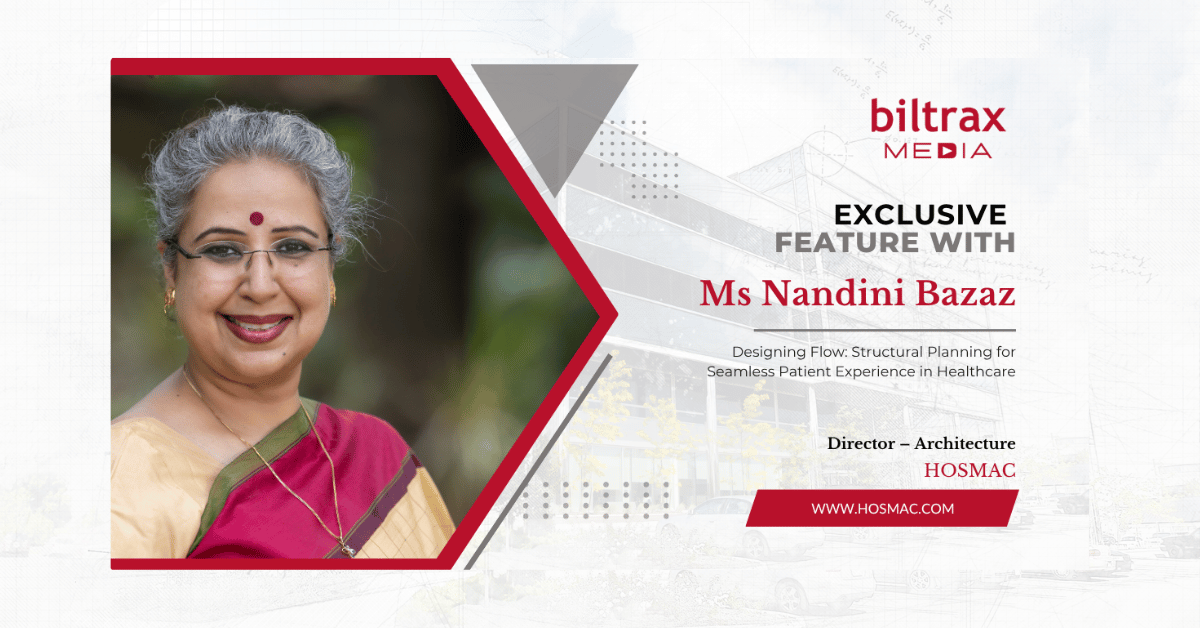
In this article with Ms Nandini Bazaz, Director – Architecture, HOSMAC, Biltrax Media explores how structural planning shapes patient movement, operational efficiency, and long-term adaptability within modern healthcare facilities.
Why Most Hospitals Feel Disconnected
Traditional hospitals have developed over time as a collection of independent departments. Diagnostic services, treatment areas, and support functions are often located across different floors or blocks, depending on availability of space and expansion needs.
This method of development leads to fragmentation in patient movement. Patients are required to navigate multiple touchpoints within the facility, often repeating processes and experiencing delays. For healthcare providers, such layouts result in longer movement paths, operational congestion, and inefficiencies in coordination.
To address this, there has been a gradual shift towards the Center of Excellence (COE) model. This approach brings together the full continuum of care within a single functional unit. Services such as consultation, diagnostics, treatment, and pharmacy are organized in proximity to each other.

Healthcare systems such as the Willis-Knighton model have demonstrated that consolidation of services improves both workflow efficiency and patient outcomes by reducing fragmentation at the planning stage.
Seamless experience, therefore, is achieved through structural organization rather than operational adjustments alone.
Flexibility & Adaptability in Structural Planning
For a hospital building to remain relevant over time, it must be capable of accommodating advancements in medical technology and changes in healthcare delivery. This requires the incorporation of flexibility within the structural framework from the initial stages of planning.
The 8–9 meter structural grid is widely regarded as an optimal planning approach for modern healthcare facilities. This grid allows for multiple configurations across inpatient rooms, diagnostic spaces, and operation theaters, enabling internal layouts to be modified without major structural disruption.
Flexibility in hospital planning operates at multiple levels. At the room scale, spaces must be able to adapt to different clinical functions. Moreover, departments should be capable of conversion without structural changes at the building scale. Meanwhile, at the complex scale, expansion must be supported through phased development. These levels work together to ensure continuity of operations as requirements evolve.
For effective conversion of spaces, adequate floor-to-floor height is required to support horizontal distribution of services such as HVAC, electrical systems, and medical gases. A minimum height of approximately 4 meters is often considered necessary to enable such adaptability.
The concept of acuity-adaptable rooms further supports this approach. In such models, patients remain in the same room while the level of care changes around them. This reduces the need for patient transfers and supports better clinical outcomes through continuity of care.
A flexible structural system also allows integration of evolving technologies and services with minimal interruption to ongoing operations. This further ensures that the healthcare facility continues to function effectively over an extended lifecycle.
Zonal Planning and Patient Movement
Planning of hospital spaces requires careful organization of functions to ensure clarity in movement for both patients and caregivers. Zonal planning provides a structured approach to achieve this by dividing the facility into distinct areas based on usage and access.
These zones typically include Public Areas, Patient Areas, Treatment Zones, and Care Provider Spaces. Each zone is planned to support a specific stage in the care pathway and is arranged to enable a logical sequence of movement within the facility.
Public areas such as entrances, waiting spaces, and registration counters are designed for ease of access. Patient areas are located with controlled entry to maintain privacy. Treatment zones are further segregated to support clinical efficiency and infection control.
This organisation supports intuitive navigation. Patients and visitors are able to move through the facility in a predictable manner, reducing confusion and improving overall comfort during their stay.

Meanwhile, separate circulation paths for staff, supplies, and patients support smooth functioning of hospital operations. The use of on-stage and off-stage movement systems allows clinical activities to be carried out without unnecessary exposure to patients and visitors.
Environmental considerations also play an important role in planning these zones. Access to natural light and external views supports patient comfort and contributes to improved indoor conditions. Daylight penetration reduces dependence on artificial lighting and supports overall well-being.
Large-scale projects such as Aarhus University Hospital in Denmark demonstrate how complex facilities can be organized into smaller, identifiable clusters. This approach improves spatial understanding and simplifies navigation for users.
Zonal planning, therefore, supports both operational efficiency and patient experience through structured spatial organization.
Structural Requirements for Advanced Medical Systems
Modern healthcare facilities require integration of advanced medical equipment, which places specific demands on structural planning. These requirements must be considered at the initial stages of design to ensure smooth installation and long-term functionality.
Equipment such as Linear Accelerators (LINACs), used in radiation therapy, can weigh up to 8.5 tons. Installation of such systems requires prior planning of movement paths, commonly referred to as the route of rigging. This includes provision of access points, transport pathways, and structural clearances to enable safe movement of equipment into designated areas.
In addition, radiation therapy units require specialized enclosures with concrete walls and ceilings of approximately 2.4 meters thickness to ensure adequate shielding. Selection of appropriate materials, such as high-density concrete, is essential to meet safety requirements while supporting cost efficiency.

Planning for such systems also influences spatial allocation and location decisions within the hospital. In many Indian healthcare facilities, oncology bunkers are positioned at ground level to reduce structural complexity and avoid additional costs associated with deep foundations and piling.
These requirements highlight the need for close coordination between architectural planning, structural design, and clinical engineering. Early integration of these factors ensures that advanced medical systems can be installed and operated without requiring major modifications at a later stage.
Planning for Staff Efficiency and Workflow
The efficiency of healthcare delivery is closely linked to the way clinical spaces are organized. Movement patterns of staff, access to equipment, and visibility of patient areas are influenced directly by spatial planning.
The concept of reach-out-routing is applied to optimize staff movement within departments. This approach focuses on reducing walking distances while maintaining clear visibility of patient zones. Frequently used spaces such as nursing stations, supply areas, and patient beds are arranged in close proximity to support efficient workflow.
In addition, decentralized nursing stations are increasingly adopted in modern hospital design. By locating smaller caregiver hubs closer to patient areas, response times can be reduced and staff distribution across the department can be improved.
Studies on staff movement patterns show that a large proportion of nursing activity occurs between specific functional links. These movement paths can be optimized through careful layout planning to improve efficiency and reduce unnecessary travel.
Efficient workflow planning contributes to improved patient monitoring, faster response in critical situations, and better utilization of staff time. Spatial organization, therefore, plays a direct role in supporting both clinical outcomes and operational performance.
Financial Considerations in Flexible Design
Structural planning decisions have long-term financial implications for healthcare facilities. Designing for flexibility enables better management of capital expenditure and supports phased development.

The concept of shelled spaces refers to areas that are constructed but not fully fitted out during the initial phase. These spaces can be developed later based on demand, allowing hospitals to expand capacity without major structural interventions.
From a financial perspective, this approach supports phased investment. Hospitals can optimise initial capital expenditure while retaining the ability to scale operations in the future.
Planning for flexibility also reduces the need for extensive retrofitting. Modifications to rigid structures often involve higher costs, disruption to ongoing services, and extended timelines.
Investments in integrated infrastructure systems, including mechanical and electrical networks, support future expansion. In some cases, upfront investments in such systems enable seamless scaling of facilities at a later stage without affecting ongoing operations.
Flexible design, therefore, supports both operational continuity and financial sustainability over the lifecycle of the hospital.
Conclusion
Hospital design continues to evolve in response to changing healthcare needs, technological advancements, and patient expectations. The focus has shifted towards creating environments that support continuity, efficiency, and adaptability.
Structural planning plays a central role in achieving these objectives. Decisions related to spatial organization, flexibility, equipment integration, and workflow design influence both patient experience and operational performance.
Healthcare facilities that are designed with adaptability in mind are better positioned to respond to future demands. Such an approach ensures that hospitals remain functional and relevant over extended periods of time.
The development of healthcare infrastructure, therefore, requires a balanced integration of architectural planning, engineering precision, and clinical understanding to support effective delivery of care.
Also Read:
Wood Wonders: 5 Ways Veneers Instantly Elevate a Rental/Urban Home
AVIARA, Delhi | Workshop for Metropolitan Architecture
Küche7 Inferno Bathroom Vanity Redefines Modern Bathroom Design

Biltrax Construction Data is tracking 38,000+ projects on their technology platform for their clients.
Get exclusive access to upcoming projects in India with actionable insights. Furthermore, gain a competitive advantage for your products in the Indian Construction Market.
Visit www.biltrax.com or email us at contact@biltrax.com to become a subscriber and generate leads.
Disclaimer: The information herein is based upon information obtained in good faith from sources believed to be reliable. All such information and opinions can be subject to change. Furthermore, The image featured in this article is for representation purposes only. It does not in any way represent the project. If you wish to remove or edit the article, please email editor@biltrax.com.
 0
0Discover more from Biltrax Media, A Biltrax Group venture
Subscribe to get the latest posts sent to your email.