


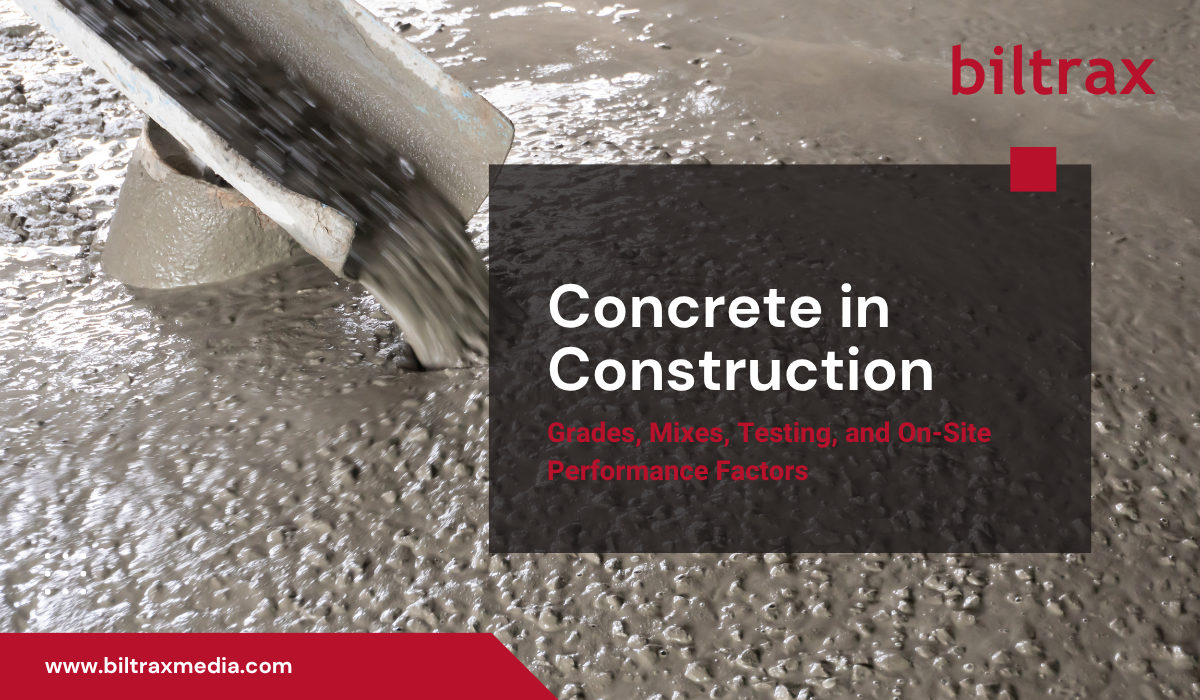
Concrete is the backbone of modern construction. From residential buildings and commercial towers to highways, bridges, and industrial facilities, nearly every major infrastructure asset relies on concrete for strength and durability. Despite its apparent simplicity, concrete is a highly engineered material whose performance depends on the careful balance of ingredients, mix design, quality control, and site execution.
A concrete structure is only as strong as the concrete placed on site. Even the most sophisticated structural design can underperform if the concrete mix is poorly proportioned, inadequately cured, or improperly handled during construction.
As India’s construction industry moves toward higher-quality, performance-driven building practices, understanding concrete grades, mix designs, testing procedures, and site performance factors has become essential for developers, contractors, consultants, and project managers.
This article explores the fundamentals of concrete and examines commonly used grades and mix proportions. It further discusses quality testing methods, highlighting the critical on-site factors that determine long-term structural performance.
Understanding Concrete
Concrete is a composite construction material made by combining:
- Cement
- Fine aggregate (sand)
- Coarse aggregate (crushed stone or gravel)
- Water
- Admixtures (when required)
When water reacts with cement during hydration, a chemical bonding process binds the aggregates into a hardened mass capable of carrying substantial loads. The strength, durability, and workability of concrete depend on the proportions of these ingredients and the quality of site execution.
Today, concrete remains the most widely used construction material globally due to its:
- High compressive strength
- Versatility
- Cost-effectiveness
- Fire resistance
- Long service life

What Do Concrete Grades Mean?
Concrete grades indicate the characteristic compressive strength achieved by concrete after 28 days of curing.
The designation follows a simple format:
M + Number
Where:
- M stands for Mix
- The number represents the characteristic compressive strength in MPa (N/mm²) after 28 days.
For example:
| Grade | Characteristic Strength |
| M10 | 10 MPa |
| M15 | 15 MPa |
| M20 | 20 MPa |
| M25 | 25 MPa |
| M30 | 30 MPa |
| M35 | 35 MPa |
| M40 and Above | High-Strength Concrete |
Higher grades generally provide greater load-bearing capacity and improved durability but require stricter quality control and mix design procedures.
Common Concrete Grades Used in India
Understanding Concrete Mix Ratios
Concrete derives its strength from the proportion of its ingredients. A mix ratio represents the relationship between cement, sand (fine aggregate), and coarse aggregate used to produce concrete.
For example:
1 : 2 : 3
means:
- 1 part Cement
- 2 parts Sand
- 3 parts Coarse Aggregate (crushed stone)
The ratio determines the strength, durability, workability, and overall performance of concrete. A higher cement content generally increases strength, while aggregate proportions influence density, shrinkage, and load-bearing capacity.
Selecting the appropriate mix ratio is essential because under-designed concrete can compromise structural safety, while over-designed concrete can unnecessarily increase project costs.
M10 and M15
These are considered lower-strength grades and are typically used for:
- Levelling courses
- Pavement bedding
- Non-structural applications
- Plain Cement Concrete (PCC) works
M10 commonly follows a nominal mix ratio of 1:3:6, while M15 uses 1:2:4.
M20 Concrete
M20 is among the most commonly used grades in residential and low-rise construction projects.
Typical Applications
- House foundations
- Slabs
- Beams
- Columns
- Flooring works
Typical Nominal Mix Ratio
1 : 1.5 : 3
(1 part Cement : 1.5 parts Sand : 3 parts Coarse Aggregate)
For every unit of cement, builders add 1.5 units of sand and 3 units of coarse aggregate to produce concrete capable of achieving a characteristic compressive strength of 20 MPa after 28 days of curing.
Developers and contractors widely use M20 concrete because it delivers an optimal balance of strength, durability, workability, and cost-effectiveness. These qualities make it suitable for most conventional reinforced cement concrete (RCC) applications, including foundations, slabs, beams, and columns.
M25
M25 marks the transition from nominal mixes to design mixes in many projects.
Typical Applications
- Structural slabs
- Beams
- Columns
- Retaining walls
- Medium-rise buildings
M25 concrete develops a characteristic compressive strength of 25 MPa after 28 days of curing, making it suitable for applications that demand higher structural performance and durability.
Instead of relying on fixed volumetric proportions, engineers typically develop M25 concrete through a laboratory-designed mix. This approach helps achieve the required strength, workability, and durability while optimising material usage.
M30 and Above
Higher-grade concretes are increasingly used in:
- High-rise developments
- Metro rail projects
- Bridges
- Industrial facilities
- Infrastructure projects
These grades offer:
- Improved durability
- Higher load-bearing capacity
- Better resistance to environmental exposure
However, they require stricter quality assurance throughout production and placement.
Nominal Mix vs Design Mix
One of the most important concepts in concrete production is the distinction between nominal mix concrete and design mix concrete. While both aim to achieve the required strength, the methodology used to arrive at the proportions differs significantly.
Nominal Mix
A nominal mix follows predefined proportions of cement, sand, and aggregates. These ratios have traditionally been used for smaller construction projects where sophisticated laboratory facilities may not be available.
Common examples include:
| Grade | Mix Ratio |
| M10 | 1 : 3 : 6 |
| M15 | 1 : 2 : 4 |
| M20 | 1 : 1.5 : 3 |
The primary advantage of nominal mixes is simplicity. Contractors can easily proportion materials on site without extensive testing. However, because aggregate properties, moisture content, and site conditions vary from project to project, nominal mixes may not always deliver the most efficient or consistent results.
As buildings become taller and structural requirements more demanding, reliance on fixed ratios alone becomes inadequate.
Design Mix
Design mixes are developed through laboratory testing based on:
- Target strength
- Workability requirements
- Environmental exposure conditions
- Aggregate characteristics
- Durability requirements
Grades M25 and above generally follow design mix methodologies.
Design mixes provide:
- Better consistency
- Optimised material usage
- Improved durability
- Enhanced structural performance
The Importance of Water-Cement Ratio
Among all variables affecting concrete quality, the water-cement ratio is arguably the most critical.
The water-cement ratio refers to:
Weight of Water ÷ Weight of Cement
A lower water-cement ratio generally leads to:
- Higher strength
- Lower permeability
- Better durability
Conversely, excessive water can create:
- Segregation
- Honeycombing
- Shrinkage cracks
- Reduced compressive strength
Industry studies consistently identify water-cement ratio as one of the primary determinants of concrete performance.
This is why adding water on site to improve workability remains one of the most common causes of concrete quality failures.
Testing Concrete Quality
Testing plays a crucial role in ensuring that concrete achieves the intended structural performance.
Quality control begins before placement and continues throughout the construction cycle.
Slump Test

Fresh concrete must possess sufficient workability to be transported, placed, compacted, and finished without segregation. The slump test is the most widely used field test for evaluating this workability.
The test involves filling a standard metal mould, known as a slump cone, with freshly mixed concrete in layers. Once the cone is removed vertically, the concrete settles under its own weight. The vertical distance through which the concrete subsides is measured and recorded as the slump value.
A low slump indicates stiff concrete that may be difficult to place and compact. Conversely, an excessively high slump may suggest that too much water has been added, potentially reducing strength and increasing the risk of segregation.
The slump test does not directly measure concrete strength. Instead, it serves as a quick quality-control tool that helps site engineers verify consistency between batches and identify changes in workability before placement.
One limitation of the slump test is that it cannot accurately predict long-term strength or durability. It simply provides an indication of the behaviour of fresh concrete at the time of testing.
Cube Compression Test

While the slump test assesses fresh concrete, the cube compression test evaluates hardened concrete and remains the primary method of strength verification in India.
During concreting operations, site engineers cast cube specimens measuring 150 mm × 150 mm × 150 mm using the same concrete placed in the structure. They then cure these cubes under controlled conditions before testing them in a compression testing machine.
During the test, the machine applies a gradually increasing compressive load until the cube fails. Engineers record the maximum load the specimen withstands and use this value to calculate its compressive strength.
Typically, cubes are tested after:
- 7 days
- 28 days
The 7-day result provides an early indication of strength development, while the 28-day result determines whether the concrete has achieved its specified grade.
For example, an M25 concrete mix should achieve a characteristic compressive strength of 25 MPa after 28 days.
Cube testing plays a critical role in quality assurance because it allows project teams to verify whether the concrete delivered on site is performing as intended. If results fall below acceptable limits, corrective measures can be taken before structural issues develop.
The test is highly reliable but has limitations. Cube specimens are cured under ideal conditions, which may differ from actual site conditions. As a result, cube strength may not always perfectly represent the strength of concrete within a structure.
Non-Destructive Testing (NDT)
In many situations, engineers need to assess the condition of existing concrete without cutting, drilling, or damaging the structure. This is where non-destructive testing becomes valuable.
Rebound Hammer Test
The rebound hammer test estimates the surface hardness of concrete. A spring-loaded hammer strikes the concrete surface, and the rebound distance is measured. Higher rebound values generally indicate harder and potentially stronger concrete.
The test is quick, economical, and widely used for preliminary assessments. However, it only evaluates surface characteristics and should not be used as a substitute for compressive strength testing.
Ultrasonic Pulse Velocity (UPV) Test
The UPV test evaluates the quality and uniformity of concrete by transmitting ultrasonic waves through the material.
The speed at which these waves travel helps engineers identify:
- Cracks
- Voids
- Honeycombing
- Internal defects
- Variations in concrete quality
Unlike the rebound hammer test, UPV provides information about the internal condition of concrete.
However, environmental factors, moisture content, and reinforcement can influence test results, meaning interpretation should always be carried out by qualified professiona
On-Site Factors That Influence Concrete Performance
Producing good concrete is only half the challenge. Site execution ultimately determines whether the concrete achieves its intended strength and durability.
Material Quality
Concrete strength begins with the quality of its ingredients. Cement, sand, aggregates, and water collectively determine the final performance of concrete. Even a well-designed mix can fail to achieve its intended strength if poor-quality materials are used.
Aggregates containing excessive dust, clay, or organic impurities may weaken the bond between cement paste and aggregate particles. Similarly, contaminated water can interfere with the hydration process and adversely affect durability.
Because aggregates typically constitute nearly 70–80% of concrete volume, maintaining consistent aggregate quality is particularly important for achieving predictable structural performance.
Batching Accuracy
Construction teams must carefully control ingredient proportions during batching, as even minor variations can significantly affect concrete performance. For instance, adding excess water may improve workability and ease placement, but it can also reduce strength, durability, and overall structural integrity. Conversely, insufficient cement content can reduce durability and load-bearing capacity.
Modern projects increasingly rely on automated batching systems and ready-mix concrete plants because they offer greater precision than manual volume-based measurement methods. Accurate batching ensures consistency across multiple pours and helps maintain compliance with design specifications.
Mixing Quality
Proper mixing ensures that cement paste coats every aggregate particle uniformly.
Insufficient mixing can create pockets of uneven material distribution, resulting in inconsistent strength throughout the concrete mass. Some areas may contain excess cement, while others may have inadequate binder content.
Uniform mixing improves workability, strength development, durability, and overall structural performance. Whether concrete is mixed manually or mechanically, achieving a homogeneous mixture remains a fundamental quality requirement.
Transportation and Placement
Concrete begins to undergo hydration as soon as water comes into contact with cement. Consequently, the period between mixing and placement is critical. Long transportation times, traffic delays, or improper handling can reduce workability before the concrete reaches its final location.
When concrete loses workability prematurely, site personnel may be tempted to add additional water, which can negatively affect strength and durability. Proper transportation planning, efficient site logistics, and timely placement help preserve concrete quality throughout the construction process.
Compaction
Freshly placed concrete contains entrapped air pockets that can weaken the hardened material if left untreated. Compaction, typically achieved using mechanical vibrators, removes these air voids and it also helps concrete settle around reinforcement bars and within formwork. Proper compaction increases density, improves bond strength, and enhances durability.
Insufficient compaction often leads to a defect known as honeycombing, where visible voids and cavities remain within the concrete. Honeycombing reduces structural strength, exposes reinforcement to moisture, and may create long-term durability concerns.

Curing
Once concrete has been placed and compacted, it must be cured to achieve its intended strength.
Curing is the process of maintaining adequate moisture and temperature conditions within concrete so that cement hydration can continue uninterrupted.
Hydration is a gradual chemical reaction, and concrete gains strength over time as this process progresses. If moisture is lost too quickly, hydration slows or stops, preventing the concrete from achieving its designed performance.
Proper curing helps:
- Increase compressive strength
- Improve durability
- Reduce shrinkage cracks
- Lower permeability
- Enhance resistance to weathering
In hot and dry climates, inadequate curing can result in surface cracking, reduced strength, and premature deterioration.
Although curing often receives less attention than mixing or placement, it is one of the most critical stages in concrete construction. Even high-quality concrete can underperform if curing practices are neglected.
Common Causes of Concrete Failure
Many concrete-related defects can be traced back to avoidable site practices.
Typical causes include:
Excess Water Addition
The most common reason for strength reduction and cracking.
Poor Aggregate Quality
Weak or contaminated aggregates compromise structural performance.
Improper Curing
Leads to lower strength and increased permeability.
Incorrect Mix Selection
Using lower-grade concrete than required can create long-term structural risks.
Conclusion
Concrete may appear to be a simple blend of cement, aggregates, and water, but its performance depends on a carefully controlled combination of materials, mix design, testing, and execution. Understanding concrete grades helps project teams select the appropriate strength for structural requirements. Proper mix design ensures the desired balance of strength, durability, and workability. Quality testing verifies compliance, while effective site practices ultimately determine long-term performance.
As India’s construction sector continues to embrace higher quality standards, sustainable practices, and performance-driven engineering simultaneously the focus is steadily shifting from simply producing concrete to delivering concrete that consistently performs throughout the life of a structure.
Modern construction demands more than selecting the right concrete grade. It requires project teams to maintain quality and precision at every stage, ensuring that concrete performs as intended throughout the life of the structure.
Also Read:
Steel in Construction: Types, Grades, Specifications, and Cost Drivers
Delhi-NCR Decongestion Push: Work on Key Road Infrastructure Projects to Start by 2027
Types of Bricks and Their Applications in India

Biltrax Construction Data is tracking 38,000+ projects on their technology platform for their clients.
Get exclusive access to upcoming projects in India with actionable insights. Gain a further competitive advantage for your products in the Indian Construction Market.
Visit www.biltrax.com or email us at contact@biltrax.com to become a subscriber and generate leads.
Disclaimer: The information herein is based upon information obtained in good faith from sources believed to be reliable. All such information and opinions can be subject to change. Furthermore, the image featured in this article is for representation purposes only. It does not in any way represent the project. If you wish to remove or edit the article, please email editor@biltrax.com.
 0
0Discover more from Biltrax Media, A Biltrax Group venture
Subscribe to get the latest posts sent to your email.