

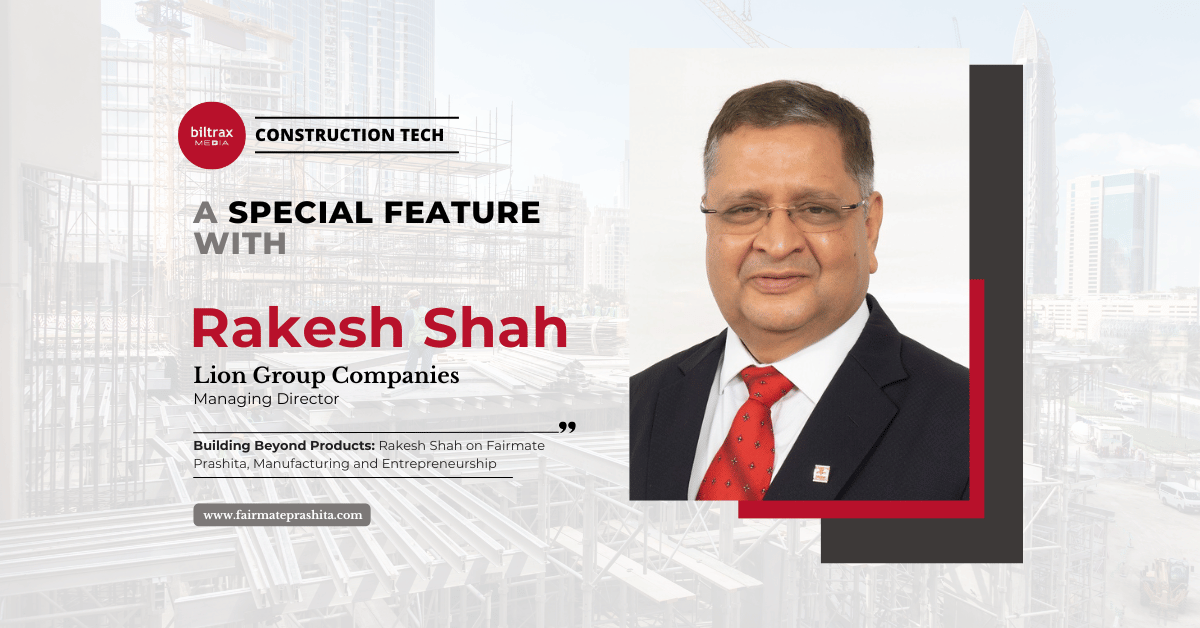
From construction chemicals to entrepreneurship, Mr Rakesh Shah shares how Fairmate Prashita is building a stronger manufacturing ecosystem through innovation, local partnerships, and skill development.
India’s construction chemicals industry has witnessed remarkable growth over the past three decades. The industry keeps evolving from a niche segment serving large infrastructure projects to an essential component of modern construction practices. As the demand for durable, sustainable, and high-performance buildings continues to grow, manufacturers are increasingly expected to do more than simply supply products. They are expected to drive innovation, strengthen local manufacturing, and contribute to the development of skilled talent.
Among the companies that have witnessed and contributed to this transformation is Fairmate Prashita LLP. Since its inception in 1996, the company has expanded its footprint beyond India, developing an extensive portfolio of construction chemical solutions while placing equal emphasis on research, manufacturing excellence, and industry development.
In this conversation with Biltrax Media, Mr Rakesh Shah, Managing Director, Lion Group Companies, discusses the journey of Fairmate Prashita. The article further explores the evolution of India’s construction chemicals industry, the philosophy behind its innovation-led approach, and the company’s vision of creating
Fairmate Prashita has grown into a multinational construction chemicals company with a presence across several countries. Could you take us through the company’s journey and the key milestones that shaped its growth?
Our journey began in 1996 with a clear objective: to deliver high-quality construction chemical solutions to the industry. Over the years, we have steadily expanded our manufacturing capabilities, strengthened our technology base, diversified our product portfolio, and increased our geographical presence.
We started as an Indian manufacturing company and now have gradually evolved into a multinational organisation serving projects across multiple countries. Throughout this journey, we have remained committed to technical excellence, product innovation, and consistent quality.
Growth, for us, has never been limited to expanding our market presence. It has also been about continuously improving our technologies, understanding changing construction requirements, and developing solutions that address the industry’s evolving needs. These principles have shaped Fairmate Prashita into the organisation it is today.
Having spent decades in the construction chemicals sector, how have you seen the industry evolve, and what changes stand out the most? What opportunities do you believe lie ahead for India’s construction chemicals industry?
The transformation has been remarkable.
When construction chemicals were first introduced in India, their use was largely confined to major infrastructure projects and large contractors. Today, the industry has evolved significantly. Awareness has expanded well beyond metropolitan cities, reaching smaller towns and regional markets where customers increasingly recognise the importance of durability, waterproofing, crack resistance, bonding strength, and long-term building performance.
This shift reflects a broader change in construction practices. The industry today is far more quality-conscious than it was two or three decades ago. Developers, contractors, and even individual customers understand that construction chemicals are no longer optional additions. They are becoming an integral part of delivering better-performing structures.
As India’s infrastructure ambitions continue to expand, the demand for high-quality construction chemicals will grow alongside them. This presents significant opportunities for companies that continue investing in innovation, product development, and customer awareness.
Fairmate Prashita often describes itself as an R&D-driven organisation. How does innovation influence your product development strategy?
Innovation has always been central to our approach. Our focus is on continuously developing technologies and improving formulations that address the changing requirements of modern construction. Rather than limiting ourselves to existing products, we invest consistently in research to create solutions that improve construction quality, increase efficiency, and deliver long-term performance.
Our research efforts span several specialised areas, including polycarboxylate ether-based admixtures, advanced waterproofing technologies, ready-made plasters, dry-mix solutions, and other niche construction chemical segments.
Every innovation is ultimately aimed at solving practical challenges faced on construction sites. Whether it is improving concrete performance, reducing application errors, enhancing durability, or increasing productivity, our objective is to develop products that create measurable value for the industry.
Fairmate serves a wide range of infrastructure and building projects. Could you share some notable sectors or applications where your solutions have made a significant impact?
Construction chemicals play a critical role across almost every segment of the built environment, and our products have supported numerous infrastructure and construction projects over the years.
Our solutions cover a broad range of applications, including concrete performance enhancement, waterproofing systems, repair solutions, protective coatings, grouts, ready-mix and dry-mix technologies, and other specialised construction chemical applications required across buildings and infrastructure. The objective has always been to provide reliable solutions that improve durability, structural performance, and long-term quality.
One of the most distinctive aspects of Fairmate’s growth strategy is its licence manufacturing model. What inspired the company to develop this approach, and how does it create opportunities for regional entrepreneurs while strengthening local manufacturing?
The licence manufacturing model was developed after recognising a practical challenge within the construction chemicals industry.
Many construction chemical products are freight-intensive, meaning transportation costs can significantly influence the final cost of the product. Manufacturing closer to the customer reduces logistics expenses, improves product availability, and enables faster deliveries while maintaining product quality.
However, our objective extended beyond improving operational efficiency.
We wanted to create a model where regional entrepreneurs could combine their local market understanding with the technical expertise of Fairmate Prashita, manufacturing systems, product technologies, quality processes, and brand support. Instead of asking entrepreneurs to build an entirely new manufacturing business from scratch, the model enables them to manufacture selected products under our guidance while following established technical and quality standards.
In this way, licence manufacturing becomes more than a business expansion strategy. It creates opportunities for local manufacturing, encourages entrepreneurship, strengthens regional markets, and contributes to the broader growth of India’s manufacturing ecosystem.
How does Fairmate’s licence manufacturing model help maintain consistent quality across regional markets, and what makes the partnership mutually beneficial for entrepreneurs?
Building a successful manufacturing partnership requires much more than providing a licence. It requires a strong support system that enables entrepreneurs to maintain the same standards that customers associate with the Fairmate brand.
Our partners bring valuable strengths to the relationship through their understanding of local markets and customer requirements. We complement that with our manufacturing systems, technical knowledge, established product portfolio, and quality processes.
To ensure consistency, we provide technical guidance, manufacturing support, quality-control systems, testing methods, and process discipline. Additionally, partners receive marketing support, entrepreneurship training, product application guidance, and technical training so that they understand both the commercial and technical aspects of the business.
Our objective is to ensure that product quality remains consistent irrespective of where the products are manufactured. At the same time, we want our partners to build sustainable businesses backed by proven technologies, established processes, and continuous technical support.
MSMEs are often regarded as the backbone of India’s economy. What role do you believe they will play in the country’s future industrial growth, and how is Fairmate contributing to this vision?
MSMEs have an extremely important role to play in India’s future industrial growth. They create employment opportunities, strengthen regional manufacturing capabilities, and contribute significantly to the country’s economic development.
However, many aspiring entrepreneurs face challenges when establishing manufacturing businesses independently. Access to technology, technical knowledge, manufacturing expertise, and market support often becomes a barrier during the initial stages.
Through our licence manufacturing model, we aim to bridge this gap by providing entrepreneurs with access to manufacturing know-how, technical training, branding support, quality systems, and products with strong market potential. We intend to expand manufacturing capacity, while encouraging entrepreneurship by creating opportunities that allow regional businesses to grow with the support of established technologies and processes. In doing so, we hope to contribute to stronger local industries and increased employment generation.
Fairmate has recently collaborated with educational and skill development institutions. What inspired this direction, and what outcomes do you hope to achieve through these initiatives?
As an industry, we have a shared responsibility to contribute towards developing skilled professionals for the future. Our collaborations with institutions such as Kaushalya Skill University, Mumbai University’s Garware Institute, and Sigma University reflect this commitment. Through these initiatives, we aim to promote technical awareness, strengthen industry-oriented learning, and encourage entrepreneurship within the manufacturing and construction chemicals sectors.
These collaborations are intended to bridge the gap between education and industry by helping students and young professionals develop practical skills, business understanding, and technical knowledge that can prepare them for careers in manufacturing and construction.
Ultimately, we hope these efforts contribute to building a larger pool of industry-ready talent while encouraging more individuals to explore opportunities in manufacturing and entrepreneurship.
Fairmate operates as part of the Lion Group of Companies, alongside businesses across multiple sectors. How has this diversified ecosystem contributed to Fairmate’s long-term vision?
Being part of the Lion Group of Companies allows us to benefit from a broader ecosystem that extends beyond construction chemicals.
The group has interests across raw material trading, architectural finishing products, precast concrete, computer software, bio-based fertilisers, and water-based degraders. This diversified presence encourages innovation, strengthens technical capabilities, and supports long-term business development across different industries.
For Fairmate, this ecosystem creates opportunities to continuously learn, innovate, and strengthen our capabilities while remaining focused on delivering quality solutions to the construction industry.
Innovation, entrepreneurship, and industry development have been central to Fairmate’s journey. Looking ahead, what kind of impact would you like the company’s initiatives to create for entrepreneurs, industry professionals, and the manufacturing sector as a whole?
Our vision extends beyond manufacturing construction chemical products.
We want to create more opportunities for entrepreneurs, encourage regional manufacturing, develop skilled professionals, and contribute to a stronger industrial ecosystem. Through our licence manufacturing model, educational collaborations, and continued focus on technology and quality, we hope to support individuals who aspire to establish and grow their own manufacturing businesses.
Simultaneously, we will continue investing in innovation and product development so that the industry has access to reliable, high-quality construction chemical solutions.
If our experience, technologies, and partnerships can help create more successful entrepreneurs, stronger regional industries, and a more skilled manufacturing workforce, we believe we will have made a meaningful contribution to the future of India’s construction and manufacturing sectors.
Also Read:
7 Innovative Building Materials That Are Changing Modern Construction
“Engineering My Own Path” – A Conversation with Sheetal Bhilkar

Biltrax Construction Data is tracking 65,000+ projects on their technology platform for their clients.
Get exclusive access to upcoming projects in India with actionable insights. Furthermore, gain a competitive advantage for your products in the Indian Construction Market.
Visit www.biltrax.com or email us at contact@biltrax.com to become a subscriber and generate leads.
Disclaimer: The information herein is based upon information obtained in good faith from sources believed to be reliable. All such information and opinions can be subject to change. Furthermore, the image featured in this article is for representation purposes only. It does not in any way represent the project. If you wish to remove or edit the article, please email editor@biltrax.com.
 0
0Discover more from Biltrax Media, A Biltrax Group venture
Subscribe to get the latest posts sent to your email.