

The construction industry has traditionally been viewed as a male-dominated domain, with women often underrepresented in technical, leadership, and decision-making roles. However, this narrative is steadily evolving as more women enter the sector, take on leadership positions, and contribute to shaping the future of the built environment.
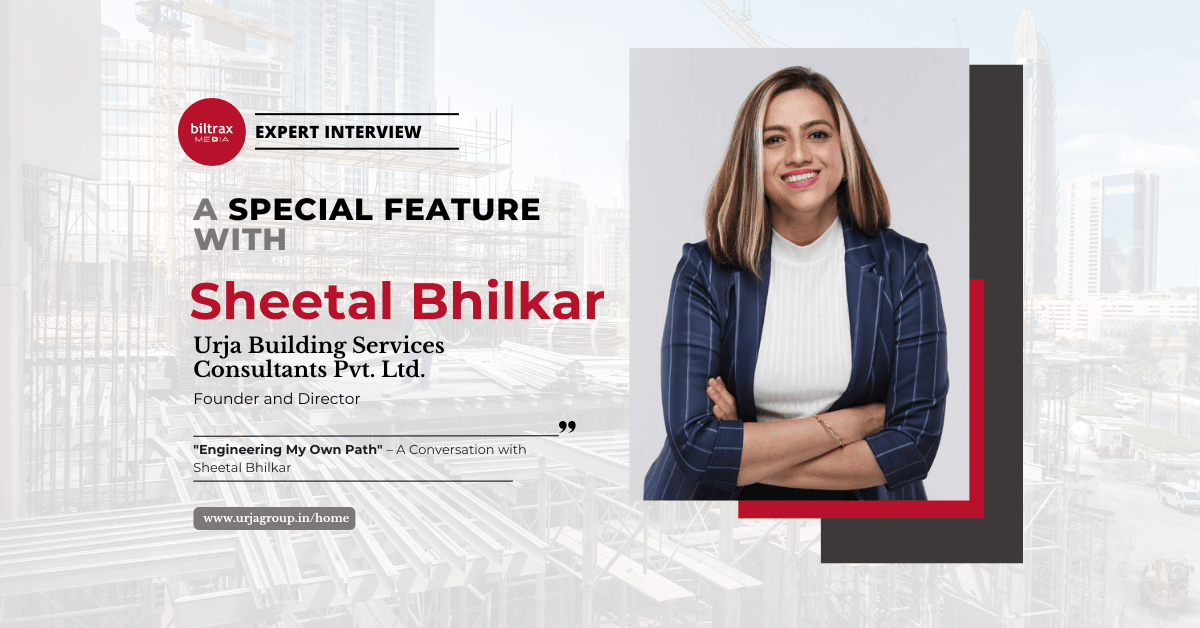
Among the professionals driving this change is Sheetal Bhilkar, a seasoned MEP consultant, entrepreneur, and industry advocate with over three decades of experience in the construction sector. As the Founder and Director of Urja Building Services Consultants Pvt. Ltd. and the Founder and President of The Real Woman Global Community (TRWGC), she has built a successful career in engineering and consultancy, while also working towards creating opportunities for women across the construction ecosystem.
In this conversation with Biltrax Media, Sheetal shares her insights on women in construction, industry evolution, and the changing opportunities for women professionals in the built environment.
1. You have spent over three decades in the construction industry. What initially drew you to engineering and MEP consultancy?
People are often surprised when I tell them this—but engineering wasn’t actually my first choice. It was my elder sister who encouraged me to pursue it because she felt it would give me a strong professional career.
To be honest, I didn’t enjoy engineering while I was studying. I think it was because we were taught formulas and theories, but nobody showed us the excitement of creating something that people would eventually use every day.
Everything changed once I started working.
The first time I visited a completed project and realised that people were living and working inside spaces I had helped design, I experienced something I had never felt before. That’s when I truly fell in love with engineering.
MEP fascinated me because most people never notice good engineering—but they immediately notice poor engineering. If a building is comfortable, safe and efficient, it usually means somebody has quietly done their job well.
That passion eventually led me to start UBSC in 2002.
Ironically, it wasn’t from an office.
It started from my home during my maternity leave, with one desktop computer and my daughter, who was just three months old.
2. MEP systems have evolved significantly over the years. What are some of the most notable changes you have witnessed in building services design and engineering?
The profession has transformed completely.
When I started, drawings were prepared manually, coordination meetings took hours and many design clashes were discovered only after construction had begun.
Today we work in a completely different world.
BIM, digital collaboration, energy modelling and intelligent building systems allow engineers to solve problems before anyone reaches the construction site.
Clients have also become far more aware. They don’t just want functioning buildings—they want sustainable, energy-efficient and future-ready buildings.
That evolution pushed us to continuously reinvent UBSC.
Today our team of nearly 94 professionals has delivered engineering consultancy for more than 760 projects covering over 175 million square feet, but we still consider ourselves students because this industry never stops evolving.
3. Looking back, what have been some of the most valuable lessons you’ve learned as an engineer, entrepreneur and industry leader?
The biggest lesson?
Technical knowledge builds projects.
People build companies.
When I started UBSC, I thought good engineering alone would guarantee success.
Today I know that culture, leadership and trust are equally important.
I’ve also learned that setbacks are often disguised opportunities.
One example was winning Walmart’s prototype project. Naturally, we hoped that would lead to many more stores.
It didn’t.
At that stage we didn’t have complete in-house Plumbing, Fire Fighting and HVAC capabilities, and they chose larger multidisciplinary consultants.
It was disappointing.
But instead of blaming the client, we asked ourselves one question:
“What do we need to become so this never happens again?”
That question changed the direction of UBSC.
4. When you began your career, construction and engineering had far fewer women than they do today. What was that experience like?
It was interesting.
The typical engineering consultant then had a very specific image—a gentleman wearing a chequered shirt, thick glasses and years of experience.
Then I walked into meetings.
Young.
Confident.
And definitely not fitting that stereotype.
I could almost read the expressions on people’s faces.
“Is she really the consultant?”
I never took offence.
People trusted what they were familiar with.
I realised very early that I wasn’t going to change opinions by arguing.
I would change them through my work.
Eventually, clients stopped noticing my age or appearance.
They remembered that I solved problems.
5. Did you encounter challenges that were unique to being a woman in the industry? How did you navigate them?
Certainly.
There were times when technical questions were directed towards male colleagues even though I was leading the project.
There were also days when I finished a client meeting and rushed home because my daughter was still an infant.
Looking back, balancing entrepreneurship and motherhood was probably harder than balancing engineering.
But I never looked at myself as a “woman trying to survive in construction.”
I simply thought of myself as an engineer.
That mindset made a huge difference.
I never entered a room believing I didn’t belong there.
6. Despite the progress made, what barriers continue to limit women’s participation and advancement within construction?
I actually think we’ve made significant progress.
Today the challenge isn’t attracting women into engineering.
It’s helping them stay, grow and lead.
Women don’t need lower expectations.
They need better opportunities, better mentors and organisations that recognise different life stages without compromising career growth.
Inclusion isn’t achieved through policies.
It’s built through culture.
7. More women are entering architecture, engineering and project management today. What advice would you give them?
Don’t spend your career trying to prove that women are as capable as men.
Spend your career becoming exceptionally good at what you do.
Competence creates confidence.
Confidence creates credibility.
And credibility opens doors.
Also, don’t wait until you know everything before accepting a new challenge.
Some of my biggest learning experiences began when I felt least prepared.
8. Are there particular areas within construction where you see significant opportunities for women?
Definitely.
Construction is becoming far more technology-driven.
BIM.
Data centres.
Digital engineering.
Sustainability.
Energy modelling.
Smart buildings.
These areas reward curiosity, collaboration and continuous learning.
I also hope we see many more women starting engineering businesses.
The industry needs more women not just as engineers, but as decision-makers.
9. What inspired you to establish The Real Woman Global Community?
Throughout my journey, I realised something.
Every successful person can usually point to one conversation that changed their life.
Unfortunately, many women never get access to those conversations.
That’s why I started The Real Woman Global Community.
Not as another networking platform.
But as a place where women genuinely help one another grow.
One initiative I’m particularly proud of is SheGuides, our mentoring programme created specifically for women in construction and the built environment.
Young professionals are paired with experienced industry leaders who understand the challenges they face.
If every successful woman mentors just one more woman, we can transform the industry much faster than any policy ever could.
10. What impact have you seen mentorship, networking and peer support create?
Confidence.
That’s the biggest impact.
I’ve seen women accept leadership roles they once declined.
Start businesses they had postponed.
Return to their careers after breaks.
Sometimes mentoring isn’t about giving answers.
It’s about helping someone believe they already have them.
That’s what SheGuides is trying to achieve.
11. How do you envision the role of women evolving within India’s construction and infrastructure sectors over the next decade?
I’m optimistic.
The next decade won’t just bring more women into construction.
It will bring more women into leadership.
Technology is changing the industry.
Leadership is changing.
Clients are changing.
The ecosystem is changing.
My hope is that one day we stop saying “woman leader.”
We simply say “leader.”
12. If there is one change you would like to see the industry embrace to create a more inclusive and supportive environment for women, what would it be?
If I had to choose one change, it would be this: trust potential before experience.
When I started my career, people often saw my age and gender before they saw my capability. I was fortunate that a few clients chose to trust me with opportunities even when I didn’t have decades of experience behind me. Those opportunities shaped my career.
As an industry, we need to create more of those moments—for women and, in fact, for every young professional. Give them meaningful responsibilities, mentor them, and allow them to learn by doing. Confidence doesn’t come before opportunity; it grows because of opportunity.
At UBSC, we’ve tried to build that culture within our own organisation, and through initiatives like The Real Woman Global Community and SheGuides, we’re extending that philosophy beyond our company. If every leader committed to developing even a few future leaders, our industry would become far more diverse, innovative and resilient.
Also Read:
The Return of Local Materials in Contemporary Architecture

Biltrax Construction Data is tracking 38,000+ projects on their technology platform for their clients.
Get exclusive access to upcoming projects in India with actionable insights. Furthermore, gain a competitive advantage for your products in the Indian Construction Market.
Visit www.biltrax.com or email us at contact@biltrax.com to become a subscriber and generate leads.
Disclaimer: The information herein is based upon information obtained in good faith from sources believed to be reliable. All such information and opinions can be subject to change. Furthermore, The image featured in this article is for representation purposes only. It does not in any way represent the project. If you wish to remove or edit the article, please email editor@biltrax.com.
 0
0Discover more from Biltrax Media, A Biltrax Group venture
Subscribe to get the latest posts sent to your email.