

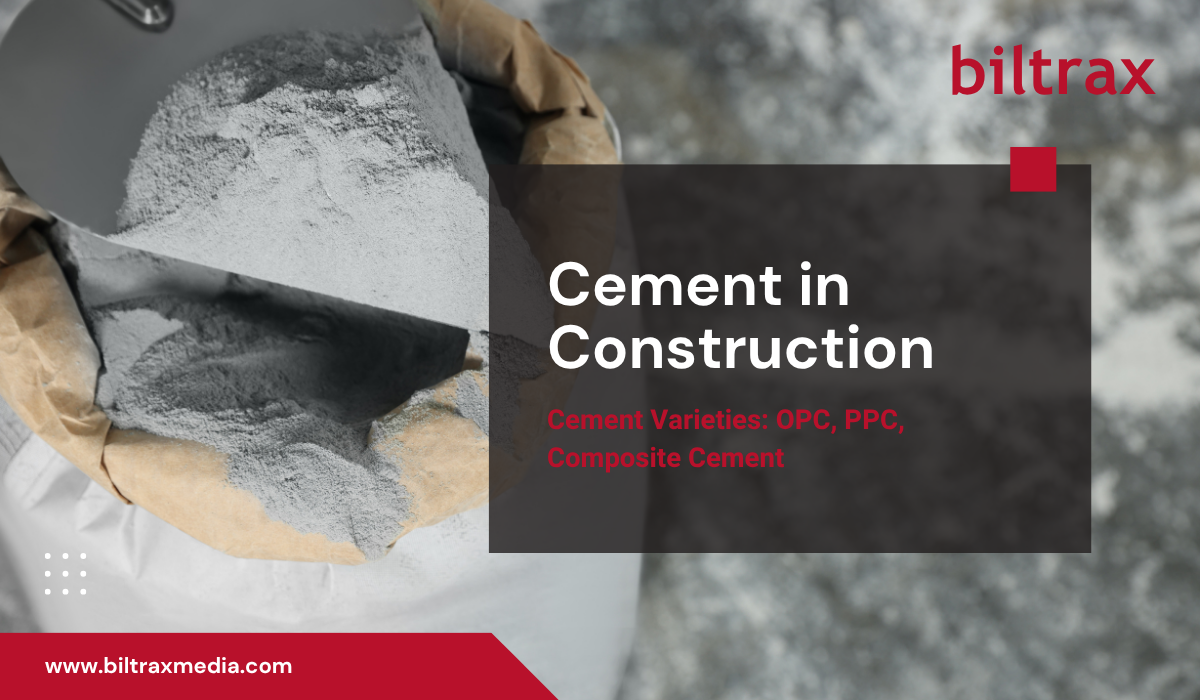
Cement is often viewed as a standard commodity in construction. Yet selecting the right cement can significantly influence a project’s structural performance, durability, construction timeline, lifecycle costs, and environmental footprint.
India’s construction industry has evolved rapidly over the past decade. High-rise developments, industrial parks, highways, metro corridors, renewable energy projects, and affordable housing programmes all demand different performance characteristics from cement. As a result, manufacturers now offer multiple cement varieties engineered for specific applications rather than a universal solution.
Among these, Ordinary Portland Cement (OPC), Portland Pozzolana Cement (PPC), Portland Slag Cement (PSC), and Composite Cement have become the most widely used options across residential, commercial, industrial, and infrastructure projects. Understanding the strengths and limitations of each variety enables project stakeholders to make informed material decisions that balance performance, durability, sustainability, and cost.
What Is Cement?
Cement is a hydraulic binder that reacts chemically with water to form a hardened mass capable of binding aggregates into concrete and mortar.
Although all cement varieties perform this basic function, their composition differs significantly depending on the addition of supplementary cementitious materials (SCMs) such as:
- Fly ash
- Granulated blast furnace slag (GGBS)
- Natural pozzolans
- Limestone
These additions influence several performance characteristics, including:
- Early strength
- Long-term strength
- Heat of hydration
- Durability
- Chemical resistance
- Permeability
- Carbon emissions
Consequently, selecting the right cement has become an important design decision rather than merely a procurement exercise.
Major Types of Cement Used in India
1. Ordinary Portland Cement (OPC)
The Benchmark for Structural Construction
OPC is produced by grinding clinker with gypsum and contains minimal mineral additives. It is the most recognised cement variety in India and serves as the benchmark against which other cement types are compared.
It is available in three strength grades:
- OPC 33 Grade
- OPC 43 Grade
- OPC 53 Grade
Each grade indicates the minimum compressive strength achieved after 28 days.
Key Characteristics
- High early strength
- Rapid setting
- Excellent workability
- Suitable for structural applications
- Widely available
Best Applications
OPC is commonly used for:
- RCC structures
- High-rise buildings
- Bridges
- Flyovers
- Industrial foundations
- Precast concrete
- Fast-track construction projects


Advantages
OPC develops high early strength, making it suitable for projects with tight construction schedules. Its rapid strength gain enables earlier formwork removal and accelerates project execution, particularly in RCC and precast construction.
Limitations
OPC generates a higher heat of hydration during the curing process, which may lead to thermal cracking in mass concrete structures. It also offers comparatively lower resistance to sulphate attack and aggressive chemical environments than blended cements.
Understanding OPC Grades
Many builders assume higher grades are always better. In reality, the grade should match the structural requirement.
| OPC Grade | Minimum 28-Day Compressive Strength | Typical Applications |
| OPC 33 Grade | 33 MPa | Masonry work, plastering, flooring, and low-strength concrete applications. |
| OPC 43 Grade | 43 MPa | Residential buildings, RCC slabs, beams, columns, and general commercial construction. |
| OPC 53 Grade | 53 MPa | High-rise buildings, bridges, flyovers, prestressed concrete, industrial projects, and heavy RCC structures requiring higher early strength. |
2. Portland Pozzolana Cement (PPC)
India’s Most Widely Used Blended Cement
PPC is manufactured by blending OPC clinker with fly ash and gypsum.
The fly ash reacts chemically with calcium hydroxide released during cement hydration to produce additional cementitious compounds, enhancing long-term strength and durability.
Key Characteristics
- Lower heat generation
- Improved durability
- Better impermeability
- Higher resistance to chemical attack
- Reduced shrinkage cracking
Best Applications
PPC is widely used for:
- Residential buildings
- Mass housing
- Masonry
- Plastering
- Marine structures
- Foundations
- Water-retaining structures


Advantages
PPC offers superior long-term durability and produces less heat during hydration, reducing the risk of thermal cracks. It also provides better resistance to moisture and chemical attack while contributing to more sustainable construction through the use of fly ash.
Limitations
PPC gains strength more gradually than OPC, making it less suitable for projects requiring rapid construction or early formwork removal. Proper curing is also essential to achieve its full performance.
3. Portland Slag Cement (PSC)
Built for Aggressive Environments
PSC incorporates Ground Granulated Blast Furnace Slag (GGBS) into OPC clinker. This significantly improves durability while reducing permeability and heat generation.
PSC is manufactured by intergrinding Ordinary Portland Cement (OPC) clinker with gypsum and Ground Granulated Blast Furnace Slag (GGBS), a by-product of the steel manufacturing industry. The addition of GGBS enhances the cement’s durability, lowers the heat of hydration, and improves resistance to sulphates and chlorides, making PSC particularly suitable for structures exposed to harsh environmental conditions.
Key Characteristics
- Excellent sulphate resistance
- High chloride resistance
- Low heat of hydration
- Enhanced durability
Best Applications
PSC performs particularly well in:
- Coastal infrastructure
- Marine construction
- Sewage treatment plants
- Ports
- Dams
- Underground structures
- Industrial plants


Advantages
PSC provides excellent resistance to sulphates, chlorides, and aggressive chemicals, making it highly durable in coastal and industrial environments. Its low heat of hydration also minimises the risk of thermal cracking in large concrete pours.
Limitations
PSC develops early strength at a slower rate than OPC, which may extend construction timelines where quick strength gain is required. Like other blended cements, it also requires adequate curing to achieve optimal performance.
4. Composite Cement
The Next Generation of Sustainable Cement
Composite Cement combines clinker with multiple supplementary cementitious materials such as:
- Fly ash
- GGBS
- Limestone
Rather than relying on a single additive, it optimises performance through a carefully engineered blend. This cement is increasingly gaining acceptance as India’s construction industry moves toward lower-carbon building materials.
Key Characteristics
- Lower clinker content
- Reduced carbon footprint
- Improved workability
- Excellent durability
- Lower permeability
- Better long-term strength
Best Applications
Composite Cement is increasingly used for:
- Residential developments
- Commercial buildings
- Industrial facilities
- Infrastructure projects
- Green building projects

Advantages
Composite Cement combines multiple supplementary cementitious materials to deliver excellent durability, improved workability, and lower permeability. Its reduced clinker content also lowers carbon emissions, making it a preferred choice for sustainable construction projects.
Limitations
Although Composite Cement performs well in most applications, its availability may vary across different regions of India. Contractors unfamiliar with blended cements may also require adjustments in curing and construction practices to maximise their benefits.
OPC vs PPC vs PSC vs Composite Cement
| Parameter | OPC | PPC | PSC | Composite Cement |
| Early Strength | Excellent | Moderate | Moderate | Moderate |
| Long-Term Strength | High | Very High | Very High | Very High |
| Heat of Hydration | High | Low | Low | Very Low |
| Durability | Good | Excellent | Excellent | Excellent |
| Sulphate Resistance | Moderate | Good | Excellent | Excellent |
| Sustainability | Moderate | High | High | Highest |
| Best For | RCC & Fast Construction | Residential & General Construction | Marine & Industrial Projects | Sustainable Multi-Sector Projects |
Which Cement Should You Choose?
The answer depends on project requirements rather than simply opting for the highest grade or strongest variety.
OPC if:
- Construction speed is critical.
- Early strength is required.
- The project involves high-strength RCC work.
PPC if:
- Long-term durability is the priority.
- The project is residential or commercial.
- Better finish quality is desired.
PSC if:
- The structure is exposed to aggressive chemicals.
- The project is located in coastal or marine environments.
- Corrosion resistance is essential.
Composite Cement if:
- Sustainability is a project objective.
- Lower carbon emissions are desired.
- Long service life is a priority.
- Green building certification is being pursued.
Key Factors to Consider Before Selecting Cement
Material selection should be based on several project-specific considerations:
- Structural design requirements
- Construction schedule
- Environmental exposure
- Climate conditions
- Durability expectations
- Cost over the asset lifecycle
- Sustainability goals
- Availability in the project region
No single cement variety is universally superior; each is engineered to deliver optimal performance under specific conditions.
Emerging Trends in India’s Cement Industry
India’s cement sector is steadily shifting toward blended and low-carbon cement solutions. Driven by sustainability targets, evolving building codes, and the demand for durable infrastructure, manufacturers are increasing the production of composite cements and other blended variants with lower clinker content.
The use of supplementary cementitious materials such as fly ash and GGBS reduces greenhouse gas emissions while enhancing long-term durability. This further makes these cements increasingly suitable for residential, commercial, and infrastructure projects. As developers pursue green building certifications and lower lifecycle costs, blended cements are expected to play a larger role in shaping India’s future built environment.
Conclusion
Cement selection is no longer just a procurement decision. It is a strategic choice that influences structural performance, durability, construction efficiency, and sustainability.
Each cement variety serves a specific purpose. Moreover, OPC remains the preferred choice for projects requiring rapid strength development and faster construction. Furthermore, PPC offers an excellent balance of durability and sustainability for general residential and commercial applications. PSC performs exceptionally well in coastal, marine, and chemically aggressive environments, while Composite Cement supports low-carbon construction without compromising on long-term performance.
Selecting the right cement should always be based on the project’s structural requirements, environmental conditions, construction timeline, and sustainability goals. As India’s construction industry further continues to evolve, choosing the appropriate cement variety will play a crucial role in delivering resilient, efficient, and future-ready infrastructure.
Also Read:
Concrete: Grades, Mixes, Testing, and On-Site Performance Factors
Steel in Construction: Types, Grades, Specifications, and Cost Drivers
Types of Bricks and Their Applications in India

Biltrax Construction Data is tracking 38,000+ projects on their technology platform for their clients.
Get exclusive access to upcoming projects in India with actionable insights. Gain a further competitive advantage for your products in the Indian Construction Market.
Visit www.biltrax.com or email us at contact@biltrax.com to become a subscriber and generate leads.
Disclaimer: The information herein is based upon information obtained in good faith from sources believed to be reliable. All such information and opinions can be subject to change. Furthermore, the image featured in this article is for representation purposes only. It does not in any way represent the project. If you wish to remove or edit the article, please email editor@biltrax.com.
 0
0Discover more from Biltrax Media, A Biltrax Group venture
Subscribe to get the latest posts sent to your email.