

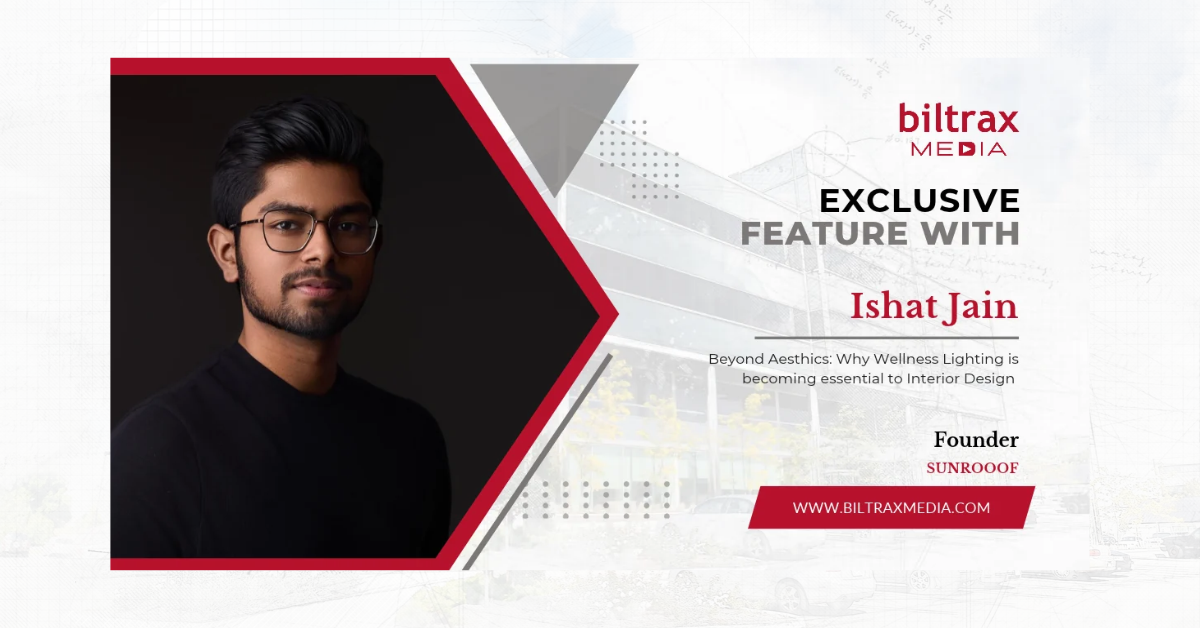
For decades, lighting was the last layer of an interior: chosen for its look, specified for brightness, and judged by how good it looked in a photograph.
That is changing. As we understand more about how light shapes the way we sleep, focus and feel, lighting is moving from decoration to infrastructure. At SUNROOOF, this shift is the reason we exist.
From Decorative to Essential
When I started working on what would become SUNROOOF in 2020, the question I kept returning to was simple: why do so many beautiful interiors still feel tiring to spend time in? What was missing was the one thing people instinctively look for when they enter a room: a sense of the sky.
Most artificial lighting is designed to help us see. Very little of it is designed to help us live well. A fixture can be elegant and perfectly placed and still give us flat, unchanging light that has little to do with the natural light our bodies evolved under. For architects and interior designers, this is no longer a minor detail. Clients increasingly expect their homes, offices and hospitality spaces to support their health, not just their taste.
That is why I believe wellness lighting will soon sit alongside acoustics, air quality and thermal comfort as a core part of good design. It is also why we built SUNROOOF around one idea: bringing the experience of natural sunlight and sky indoors.
Light, the Body and the Circadian Rhythm
It is widely accepted that light is one of the main signals our bodies use to keep time. Our internal clock, the circadian rhythm, responds to the brightness, colour and timing of the light we receive throughout the day. Bright, cooler light in the morning helps us feel alert, while warmer, softer light later in the day helps us wind down. When we spend most of our hours indoors under the same light from morning to night, that signal becomes blurred.
Light also shapes mood and visual comfort. Glare, harsh contrast and flat illumination make a space feel tense, while gentle, natural-feeling light makes it feel open and calm.
We did not set out to make another light fitting. We set out to give people back the sky they lose when they walk indoors.”
At SUNROOOF, we treat these principles as the starting brief. Our patented wellness lighting technology is designed to recreate the feeling of natural daylight and sky, so that a room responds to people the way the outdoors does, rather than simply being lit.
Designing for Spaces Daylight Cannot Reach
Every designer knows the spaces that fight back: the basement that becomes a gym or media room, the deep-plan office where desks furthest from the façade never see a window, the enclosed bathroom, the internal corridor, the windowless meeting room, and the lower-ground lounge in a hotel. These are often the hardest rooms to make feel generous, and people usually spend more time in them than we expect.
Traditionally, the answer has been more light: more downlights, more coves, brighter lamps. But more light is not the same as better light. What these spaces lack is not brightness, but the quality of a connection to the outdoors.
This is where SUNROOOF has had the most profound impact on projects. Across more than 1,800 installations in India and the UAE, we have seen basements, enclosed rooms and deep-plan interiors take on a completely different character once they carry the experience of a skylight.
How Designers Can Integrate Wellness Lighting
Wellness lighting works best when designers incorporate it from the beginning, rather than adding it once the ceiling is closed. A few principles guide how we work with architects and interior designers:
Start with how the space is used. A bedroom, a home office and a spa treatment room each need light to behave differently through the day. The lighting concept should follow the rhythm of the people using the space.
Think of light as an architectural element. A SUNROOOF installation often becomes the focal point of a ceiling, so designers should consider it alongside the plan, ceiling geometry and material palette, just as they would a real skylight.
Layer, don’t flood. Wellness lighting sets the base mood of a room; task and accent lighting still have their place. The goal is a balanced composition, not a single bright source.
Experience it before specifying it. Light is difficult to judge from a drawing or a render. That is why we created Experience Centers in Jubilee Hills, Hyderabad, together with MAGPPIE, and in Indiranagar, Bengaluru, where designers and their clients can stand under SUNROOOF and feel the difference for themselves.
Light is the one material in a room that you cannot touch, yet it changes how you feel about everything you can.”
Design and Science, Not Design or Science
I left school at 14, and much of what I know about light I learned by building, testing and failing. SUNROOOF took more than four years of research and development and over 100 prototypes before we launched commercially in 2024. Through that process, one lesson became clear: wellness cannot come at the cost of beauty. If a product does not belong in a well-designed room, designers will not use it, no matter how good it is for people.
That is why recognition from the iF Design Award and the Good Design Award in 2024 mattered so much to our team of about 100 people. It confirmed that wellness lighting can meet the same design standards as any other element in an interior.
Where the Industry Is Heading
I believe we are at the beginning of a larger change. Over the coming years, I expect wellness lighting to move from a premium feature to a basic expectation in homes, workplaces, hospitality and healthcare. Clients will ask not only how a space looks, but how it makes them feel at eight in the morning and at eight at night. Architects will plan deeper buildings and more below-ground space with confidence, knowing that a lack of windows no longer has to mean a lack of light.
For SUNROOOF, the mission is to make that future practical for designers today: to give them a way to bring the sky into any room, and to make wellness a natural part of the design language rather than an add-on.
Closing Thoughts
Good design has always been about people. Lighting is simply catching up. The most important question we can ask of a light is no longer only “How does it look?” but “How does it make us feel, and how does it help us live?” When we design with that question in mind, we move beyond aesthetics, and that is where I believe the best interiors of the next decade will be made.
Also Read:
Churrolto, Hyderabad | Fellow Yellow
Out With the Beige, In With the Bold: Chairs That Bring the Party Home
India’s Building Materials Sector Looks to Deepen Its Presence Across Asia

Biltrax Construction Data is tracking 65,000+ projects on their technology platform for their clients.
Get exclusive access to upcoming projects in India with actionable insights. Furthermore, gain a competitive advantage for your products in the Indian Construction Market.
Visit www.biltrax.com or email us at contact@biltrax.com to become a subscriber and generate leads.
Disclaimer: The information herein is based upon information obtained in good faith from sources believed to be reliable. All such information and opinions can be subject to change. Furthermore, The image featured in this article is for representation purposes only. It does not in any way represent the project. If you wish to remove or edit the article, please email editor@biltrax.com.
 0
Discover more from Biltrax Media, A Biltrax Group venture
Subscribe to get the latest posts sent to your email.